|
|
The BEST Juicer, Is there one?
by John Kohler (updated Feb 2017)Often times, we are asked, "which
is the best juicer?". Choosing a juicer is like a choosing an outfit to
wear. If your going swimming, you will wear a bathing suit. If you are going
to a formal occasion, you will wear an tuxedo. Choosing a juicer is much the same.
You must match the juicer to what you intend to do with the juicer. There are
several "styles" of juicers available on the market today. Some are better
suited for juicing certain kinds of produce than others. There is no
"perfect" juicer that will perform every juicing operation with equal quality.
Please evaluate your needs carefully before purchasing an appliance. This
article is based on our experience, and is accurate as possible, if you have any
questions, please visit the FAQ.
| Before purchasing a juicer, you should ask
yourself, what considerations are important to you, when making your choice? Some
factors you should take into consideration are: |
- ease of cleaning
- noise level
- speed of juicing
- length of warranty
- types of produce you will be juicing
- quality of the
juice
|
One of the reasons why there is not a "perfect"
juicer is because fruits and vegetables have vastly different properties. The
juicing method that is effective for one may not work while juicing the other.
Fruits, have soft cell walls, and therefore require a gentle extraction method.
Apples, pears, watermelon, cantaloupe, pineapple are some of the fruits that can be juiced
peel and all. Citrus fruits, such as oranges, grapefruits, tangerines, have a bitter
outer rind, and juice from a "whole" orange would be too bitter to drink.
It also contains indigestible chemicals. One solution is to grate away the outer
rind (the orange coloring on the orange - it is best to leave the white "pith",
as valuable nutrients are contained within the white area). The more common method,
is to slice the fruit in half, and then using a "reamer" style juicer or a
citrus press to press out the juice.
* I always recommend people purchase organically grown
produce whenever possible, especially when juicing produce items, skin and all.
Even better than buying organic is growing your own produce.
Vegetables on the other hand have fibrous, "tough"
cell walls, requiring more aggressive mechanical juicing action than fruit. Due to
their low acid content, it is recommended that vegetable juices be consumed within 15
minutes of their preparation, since it has been demonstrated that enzyme activity in juice
30 minutes may be less than a fresh juice. When apple or carrot juice
turns brown, it has oxidized and the nutrition has lessened.
Juices that are not made fresh, and sold in the store that
are bottled or canned will NEVER oxidize. This is because the juice has been heated
to deactivate all the enzymes. The enzymes are one of the key reasons why making
fresh juice with your juicer can be so beneficial. Other
benefits are some of the phytochemicals, phytonutrients and antioxidants
that can be lost during commercial processing.
I will attempt to explain they various styles of juicers on
the market today, how they work, and a brief overview of their advantages and
disadvantages.
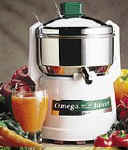 Centrifugal Juicers Centrifugal Juicers
The centrifugal juicer design is one of the oldest juicer designs.
This juicer uses a grater or shredder disc and a strainer basket with straight sides to
hold the pulp in the machine. The shredder disk is at the bottom of the basket,
which revolves at a high speed (3600 rpm). The produce is put into the top of the
machine, and it pressed through a chute, hits the spinning shredder disc, while the
produce is being shred, juice is released. The basket spins at a high speed,
much like a washing machines spin cycle and force pushes the juice through the strainer
basket, and comes out of the front of the machine, and the pulp stays inside the
machine. Generally this style juicer can make 1-2 quarts before the juicer must be
stopped, and the pulp must be removed before further juicing can take place. This is
not a continuous juicing appliance. The two centrifugal juicers we sell are the Omega 1000 and Omega 9000. These
machines use stainless steel baskets and ball bearing induction type motors. The Omega
1000 offer a 10 year warranty, and the Omega 9000 offers a 15 year warranty. This
juicer is good for juicing most fruits and vegetables. This
style juicer tends to inject air into the juice so it reduces the
nutritional content and oxidizes the juice.
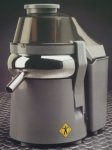 Centrifugal Ejection
Juicers Centrifugal Ejection
Juicers
Made popular by the "Juiceman" Infomercial in the 1990's and the
Jack Lalanne Infomercial in the 2000's... The centrifugal ejection style juice
is the next juicer we will be explaining. This juicer operates much the same way as
the centrifugal juicer above operates, except for the sides of the basket is slanted.
This allows for the basket to be "self-cleaning", so there is no need to
stop the juicer and empty it out. The pulp is ejected out of the machine, usually
into a collection bin or basket, that can be lined with a plastic bag to collect the pulp,
and then easily discarded. Due to the short contact time of the pulp in the basket, these
juicers need to spin faster than the centrifugal juicer, at 6300+ rpm. This style
juicer is the noisiest of all the juicers. The Omega 4000(15
year warranty) and Lequip 110.5 (10 year
warranty).
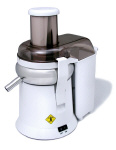 Centrifugal Ejection
Wide Feed Chite Juicers Centrifugal Ejection
Wide Feed Chite Juicers
Much like the centrifugal ejection juicers, above,
except it has the addition of a large feed chute which is 3" in diameter, which allows the user to juice
without cutting the produce. Due to the larger feed chute, the RPMS
are also increased, which can be as much as 11,000 RPM. There are benefits and drawbacks to the large feed
chute. The units we offer with the large feed chute are: Lequip 215XL (10 year warranty) and the
Breville Juice Fountain Elite (1 year warranty). To
read more about the advantages and drawbacks of the wide feed units, click here. The centrifugal ejection juicers
are the easiest to use and easy to clean, and are fast. They are good
for juicing most fruits and vegetables. This style juicer creates a
less nutritious juice than the slow juicers.
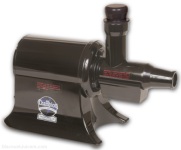 Masticating Juicer Masticating Juicer
The Champion Juicer, made by Plastaket, combines three
operations into one. The Champion Juicer first grates, then masticates or chews the pulp
to further break down the cell-wall structure, and then mechanically presses or squeezes
the pulp to extract the juice. The Champion uses a powerful
1,725 RPM motor and requires moderate strength to operate. It is definitely not a
machine for a physically limited person. It can juice almost every type of vegetable
efficiently, including leafy vegetables. By blocking off the juice spout (with the blank
or solid plate), the Champion can be used as a homogenizer to
make such foods as raw applesauce, tomato sauce and baby food. It can make peanut butter
or other nut butters. It also makes wonderful ice cream-like desserts from raw frozen
bananas and other fruits. By assembling the Champion without the blank or juicing screen,
it can be used as a grater or to make shave ice. The Champion's
motor is manufactured by General Electric and its juicing parts are constructed of
stainless steel and nylon; it has been manufactured since the 1950's. It is best for
juicing most fruits and vegetables. Plastaket also manufacturers a more powerful version
of the Champion juicer, its the Champion Commercial model.
The difference is that it has a bit more powerful motor. The look of the machine is the same, as well as all the external parts.
Due to the way the Champion juicer works, it tends to oxidize the food more
than the slow juicers, below.
 Manual
/ Hydraulic Press Juicers Manual
/ Hydraulic Press Juicers
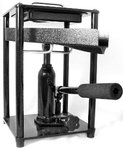
The press style juicer squeezes the juice out of the produce by
pressure. The press juice, its a two step process: first the produce must be
shredded then it is pressed. The Norwalk and
Pure Juicer are electric two
step juicers that combines grating and pressing operations into one unit, with this
machine, the vegetable or fruit is first grated by a revolving cutter into a linen cloth lined tray, which was then placed into a motor-driven hydraulic press. Extremely high
pressure is used to extract juice from vegetables (1,700+ PSI), The hydraulic
press produced a high- quality juice from both fruit and vegetables, but it was a
difficult and time- consuming machine to use and to clean. In addition, these
machines cost in excess of $2200+, which is quite high for the average consumer. A good substitution for the Norwalk
juicer, would be to use the Champion Juicer as a grater, and
then the Welles press, which are operated manually that squeeze the juice out of the produce.
While Grinding the produce at high speed 3000+ RPM can cause some
oxidative damage to the produce, the pressing step causes the least oxidation of the juicing methods, and produces a pulp
free juice, since the juice is strained through cheese cloth. This type of juicer
juices fruits (especially soft ones) better than other types of juicers.
 Single Auger
Horizontal Juicers (Cold Press Slow Juicer) Single Auger
Horizontal Juicers (Cold Press Slow Juicer)
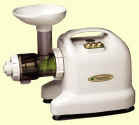
This juicer produces juice by using a single auger that basically crushes the
produce into the walls (or screen) of the juicer, and in the process extracts the
juice. It runs at 80 RPM, so there is little oxidation. The single auger
style juicer has been on the market as a dedicated wheatgrass
juicer for many, many years now. Just recently, a new design of the machine
allows the single auger style machine to juice wheatgrass as well as other vegetables and
fruits. There are several brands of single auger juicers. The Samson 9001 (10 year warranty). This new single auger machine
juices wheatgrass about as well as a dedicated wheatgrass juicer and does an excellent job
juicing leafy greens. It will juice fruits and other vegetables about as well as the
twin gear juicers (below). We found that this type of machine was not as effective
at juicing carrots, as the twin gear units. (read more about
that here) The juice made with this machine tend to be really pulpy
and it is advised to use the strainer that is included. Fruits and non leafy
vegetables need to be cut into small "cubes" for best results when using this
juicer. We find that the single auger juicers, do not produce a high yield when
juicing carrots, so if you want to juice alot of carrots, this is not the juicer for
you. For best results when using this machine, the hard and soft produce needs to be
"alternated" when feeding into the juicer. As with the twin
gear units below, this machine is not the greatest for juicing fruits.
 Dual
Stage
Single Horizontal Auger Juicers (Cold Press Slow
Juicer) Dual
Stage
Single Horizontal Auger Juicers (Cold Press Slow
Juicer)
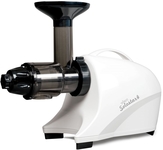
This juicer works like the single auger style juicer above,
but upon the initial crushing of the produce, juice is directed through the
stage one juicing screen into the juice cup. The crushed produce continues
its way through the machine to the 2nd stage, where there is a finer holed
screen to further obtain more juice. With the single stage auger
juicers (above), the juice is only produced in this second stage.
In our tests, this style juicer produced more juice and worked better than
the single auger juicers. There are two brands that sell the dual stage
single auger juicers. Omega offers the 8003 and 8005 model
(10 yr warranty). The Omega models are identical except for the color.
The 8003 is white, and the 8005 is a chrome color. The
Omega 8004
and 8006 are the upgraded versions of the 8003
and 8005. They include a 15 year warranty, as well as an 8x
harder auger. The latest version the dual stage single auger is the
Omega NC800 that is easy to clean and gets a
higher yield than previous Omega models. The more powerful, and
lower RPM(58), Tribest
Solostar 4 is more difficult to clean than the
Omega NC800 but extracts even more juice than the NC800. We found that
this type of machine was more effective juicing than the single auger style
juicer. (read a sample test here). We prefer the
Omega NC800 because it is easiest to clean in
the class or the Solostar4 because it gets the
highest yield in this class.
 Single Auger
Vertical Juicers (Cold Press Slow Juicer) Single Auger
Vertical Juicers (Cold Press Slow Juicer)
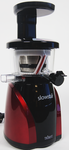
This juicer is similar to the horizontal auger design
(above) but has the auger vertically instead. This juicer runs at
80rpm. This has several benefits: First, the juicer takes up
less counter space. Second, the juicer is better at juicing a
wide variety of produce, such as leafy greens, hard vegetables and fruits.
Third, total juicing time takes less time because the juicer can feed itself
instead of you having to push produce into the juicer. The
Omega VRT330(10 year warranty),
Omega VRT350(10 year warranty)
Omega VRT400(15 year warranty) were the first
generation of this style machine that has a pulp ejection hole in the bottom
of the screen that can have a tendency to clog.
The second generation of
this machine eliminated the pulp ejection hole in the bottom of the screen
which minimizes clogging and the need to pre-cut produce into smaller pieces
so it does not clog this hole. They also run at a lower RPM(43-47)
than the standard vertical single augers. The
Slowstar (10 year warranty) is the most versatile, most powerful and the
lowest cost. The Omega VSJ843(15 year
warranty) comes in a square and
round design as well as different colors.
It is a bit easier to clean than the Slowstar
juicer, but does not include an attachment to make fruit sorbets and nut butters.
Although it is a little easier to clean and produces less pulp in the juice.
We prefer the
Slowstar overall due to its lower cost and
versatility.
 Single Auger
Wide Feed Chute Vertical Juicers (Cold Press) Single Auger
Wide Feed Chute Vertical Juicers (Cold Press)
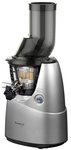
The newest style of vertical single auger juicer on the
market is the Kuvings Whole slow juicer. The difference with this
model vs all previous vertical slow juice extractors is the addition of a 3"
wide feed chute.
This 3" wide feed chute
makes it easier to use the juicer with less cutting of produce to fit into
the feed chute.
This style machine has all
the pros and cons of the Single Vertical Auger style juicers.
The Kuvings
Whole Slow Juicer b6000 (10 year warranty) and the
Kuvings Whole Slow Juicer Elite c7000 (10 year warranty)
are the only wide feed chute juicers we offer at this time. We find
the c7000 model works better, jams less, and extracts a higher yield than
the b6000 model. Kuvings owns the patent on wide feed chute slow
juicers and other machines may be poor-performing knock-offs.
 Twin Gear Press
(Cold Press Slow Juicer) Twin Gear Press
(Cold Press Slow Juicer)
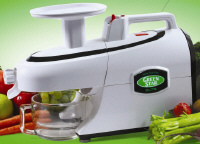
These juicers have two gears that basically press out the juice of the
produce. The screws turn at a low 90-110 rpm. It is very similar to two gears
in a automobile transmission that mesh together. Basically, the produce is pushed
(with some force) into the two gears, which first shreds, and then squeezes the produce.
These machines are best for juicing vegetables since these machines rely on the
fibrous cell wall to push the pulp through the machine. As a bonus, these
machines will also juice wheatgrass (Generally a separate wheatgrass
juicer is required to juice wheatgrass). The quality of the juice produced with
these machines can be compared to the quality of the hydraulic press above. These
machines are not for the"faint" or "frail" hearted as some pressure is
needed to feed the produce into the machine. Machines in this category are the
Green Star Juice Extractor (5 year warranty) ,
The Green
Star Elite GSE-5000 (12 year warranty),
Green Star Pro GS-P502A (15 year warranty), and Green Power
KPE1304 Juicer (10 year warranty) .
These juicers truly give "the best of both worlds" but there is one
drawback: the price. They can be as much as two to three times the price of the
Centrifugal or Mastication Juicers. While these juicers are best for juicing
vegetables, the Green Power and Green Star machines have a fruit
attachment available to help it better juice fruits. (We have
successfully juiced hard apples, hard pears, watermelon with rind, and
citrus successfully with these twin gear machines). We do not
recommend these juicers if you want to juice a significant amount of fruit. The
Green Star, Green Star
Elite and Green Power KPE-1304 are
also able to homogenize as the Champion above, and make raw apple sauce,
delicious fruit sorbets, nut butters, baby food. We recommend
the Green Star Elite, which is the latest
design that uses 3 unique pressing stages.
How loud are the juicers?
The noise level of the juicers are all different. A good rule of thumb: The
faster a juicer turns (Revolutions Per Minute) or RPM, the louder the machine is.
Based on this, the Single Auger and Twin Gear Machines would be the quietest
operating at
~100 rpm) , followed by the Champion (~2700 rpm) ,then the centrifugal machines (~3600
rpm) , with the centrifugal ejection (~7200 rpm) machines being the loudest. I have
personally juiced with the Green Power while my roommate was sleeping, and it didn't bother
them. I would never try that with any of the other juicers, as they are much
louder! Read our article, "How loud is that Juicer in
the Window" for the results of our juicer decibel testing.
Recommendations:
I find that my personal favorite, for fast, easy and quick
fruit and vegetable (with minimal leafy green vegetables) juice making is the centrifugal ejection juicers. The
Lequip 110.5 is my favorite centrifugal
juicer. It's easy to clean and gets a good
extraction from the produce. They will juice most fruits (including the skin) and
vegetables. For more convenience, you may want to consider the
Lequip 215xl, which has the larger feed
chute which will save additional time.
People who are primarily interested in leafy
green and vegetable juices
as well as wheatgrass, should seriously consider a horizontal single auger
such as the Omega NC800 or
Solostar 4.
They were specifically designed to produce its highest quality juice from
leafy greens and hard vegetables. The
juice it produces from vegetables is darker, more concentrated, and contains less
entrapped air than juice made with a centrifugal juicer. For this reason the juice has
slightly longer shelf life.
For people that want to
juice leafy greens, hard vegetables as well as fruit, you can't beat a
vertical single auger juicer for its versatility. I would choose
either the Slowstar or
Omega VSJ843 as they are the best performers
in this category.
For people that want the highest quality juice, the twin gear
press. They are more
efficient (especially juicing hard vegetables with leafy greens) than the other juicers mentioned. Since
they operate at a low RPM, it is the quietest of all the juicers, and due to the low rpm,
the oxidation that occurs while juicing is minimized (this maximizes the nutritional value
in the juice). If you have the money, and you will be juicing mostly
vegetables and some fruit. (This is not the
machine for you if you want to juice mostly fruit - it was designed to juice
vegetables) The Green Star
Elite is the best juicer in its class. This juicer is best for
hard vegetables with leafy greens, and are not
recommend for people who want to juice mostly fruit. If juicing a combo drink, juice
the softest item first, followed by the harder item and alternate them. (ie: apples then
carrots). This is because the twin gear machine REQUIRES fiber (such as in veggies)
to push the pulp through the machine, or it will back up.
For people who are interested in changing their lifestyle,
and interested in the Living/Raw Food Diet,
I would highly recommend either the Slowstar,
Solostar 4 or
Green Star Elite
juicers, due to the features besides juicing. The homogenizing feature comes
in VERY handy for making raw/living food
recipes. We personally like the Slowstar since it
juices leafy greens and wheatgrass really well, and run at a lower RPM, as well as being
more affordable than the Twin Gear juicers.
If you want to produce high quality wheatgrass juice, a
slow-turning manual-type juicer such as the Back to basics stainless steel produces the
best quality. There are many motorized varieties of wheatgrass juicers such as the Miracle MJ-550 to make it easier to juice
wheatgrass. The would generally recommend the multi-purpose
Solostar 4 for people that
want to juice wheatgrass as well as other types of produce.
On a budget? Please read our budget juicer article to learn about the juicers around
$100. that will give you the most bang for the buck..
Be sure to take a look at all the other
articles we offer about juicers before making your purchase.
We highly recommend watching the demonstration
videos we have available so that you can become more educated about the machines, and
see how they are used. Our videos contain the latest updates,
information and testing of the juicers. |